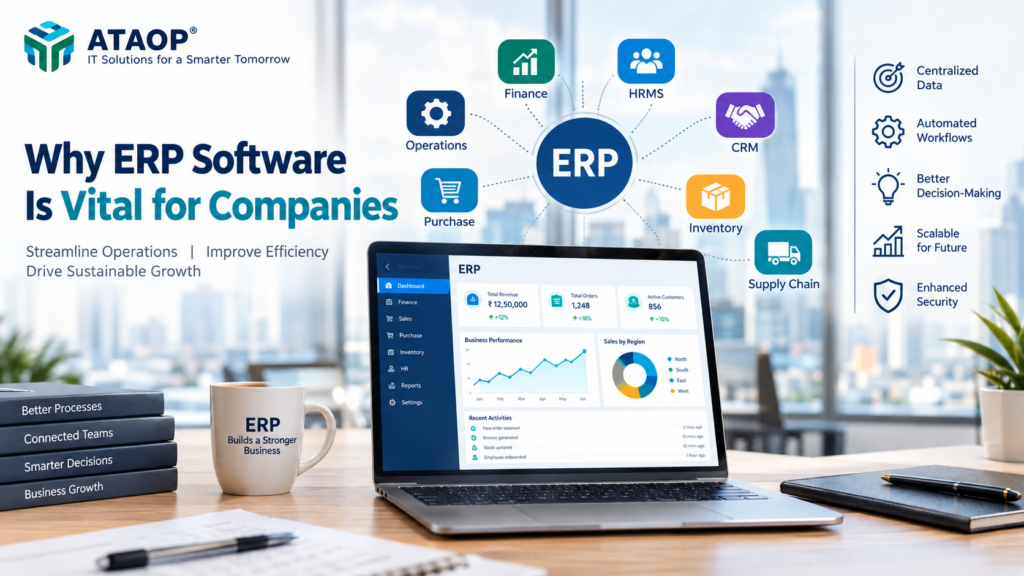
As companies grow, managing sales, finance, inventory, purchasing, employees, customer information and daily operations through spreadsheets or disconnected applications becomes increasingly difficult. Data gets duplicated, employees spend time on repetitive tasks, and management may struggle to obtain accurate information when it is needed.
This is where ERP software becomes important.
ERP, or Enterprise Resource Planning, is a business management system that connects multiple departments and processes through a centralized platform. Modern ERP solutions can bring together finance, procurement, inventory, sales, operations, reporting and other business functions while allowing teams to work with shared information. Oracle describes ERP as an integrated suite designed to provide a common data model and a single source of truth across business processes.
For growing organizations, ERP is not simply another software investment. When properly selected and implemented, it can become an important foundation for business process automation, operational visibility, data management and informed decision-making.
What Is ERP Software?
ERP software is a centralized business management solution designed to connect different operational functions within an organization.
Depending on the company’s requirements, an ERP system may include modules for:
- Finance and accounting
- Sales management
- Purchase management
- Inventory management
- Supply chain operations
- Customer relationship management
- Human resources
- Payroll-related workflows
- Project management
- Reporting and analytics
- Business process automation
The major advantage is that these functions can work with connected data instead of maintaining completely separate records. SAP explains that ERP systems use integrated modules that share a common database, allowing information from different business areas to work together.
Why Is ERP Software Vital for Companies?
The importance of ERP becomes more apparent as a company handles larger volumes of customers, transactions, employees, products and operational data.
Here are some of the key reasons businesses consider ERP software an essential part of their technology infrastructure.
1. ERP Centralizes Business Data
One of the biggest challenges for growing businesses is fragmented information.
A sales team may maintain customer records in one application, the accounts department may use another system, while inventory information remains in spreadsheets. This creates information silos and makes it difficult to understand the complete business picture.
An ERP system can bring important business information into a centralized environment.
For example, when sales, inventory, purchasing and finance data are connected, management can get a broader view of business activity without repeatedly collecting information from different departments.
This centralized data management approach can also reduce duplicate data entry and make internal reporting more consistent.
2. ERP Reduces Manual and Repetitive Work
Manual processes consume valuable employee time.
Entering the same information into multiple spreadsheets, preparing repetitive reports, checking order statuses and following up on approvals can slow down daily operations.
ERP software can automate many routine workflows.
Common examples include:
- Purchase order workflows
- Invoice processing
- Inventory updates
- Approval processes
- Sales order management
- Employee-related requests
- Automated alerts
- Business reports
- Data synchronization
Modern ERP systems increasingly incorporate automation and intelligent technologies to reduce manual work. Oracle notes that ERP automation can reduce repetitive effort and support processes such as order fulfillment, inventory management, invoice generation and reporting.
The objective is not necessarily to eliminate human involvement. Instead, automation allows employees to spend less time on repetitive administrative activities and more time on work that requires judgment and expertise.
3. ERP Improves Business Decision-Making
Good business decisions depend on reliable information.
If management receives sales or financial reports several days after an event, the information may no longer represent the current operating situation.
ERP systems can provide access to more current operational and financial information, depending on the system architecture, integrations and implementation.
This can help businesses monitor areas such as:
- Sales performance
- Inventory levels
- Purchase activity
- Revenue
- Expenses
- Customer orders
- Operational performance
- Business KPIs
Real-time or near-real-time information can make it easier for managers to identify changes and respond appropriately. SAP and Oracle both highlight improved visibility and access to current business information as important ERP capabilities.
4. ERP Connects Different Departments
A business works as a connected organization, even when its departments have different responsibilities.
For example, a customer order may involve sales, inventory, procurement, finance, logistics and customer support.
Without integrated systems, employees may need to exchange information manually between departments.
ERP integration helps connect these processes.
When business applications share information, departments can work from a more consistent data foundation. IBM identifies unified real-time data, a single source of truth and workflow automation among the benefits of ERP integration.
This can improve collaboration and reduce the operational friction created by disconnected systems.
5. ERP Helps Improve Operational Efficiency
Operational efficiency is another major reason companies adopt ERP solutions.
Instead of maintaining separate systems for every department, organizations can design connected workflows around their actual business processes.
For example:
Customer Order → Inventory Check → Purchase/Production → Approval → Invoice → Delivery → Reporting
An integrated ERP environment can help coordinate these activities within a structured workflow.
The exact benefits depend on the organization’s processes, software configuration, data quality and implementation approach. ERP does not automatically solve inefficient processes simply by being installed. Businesses still need proper process mapping and implementation planning.
6. ERP Supports Better Inventory Management
For businesses dealing with products, materials or multiple warehouses, inventory visibility can be critical.
An ERP system can help organizations manage information related to:
- Stock levels
- Purchase orders
- Suppliers
- Product movement
- Warehouses
- Sales orders
- Inventory requirements
- Reordering workflows
Better inventory information can help businesses avoid unnecessary overstocking while reducing the risk of unexpected shortages.
ERP becomes particularly useful when inventory data needs to interact with purchasing, sales and finance rather than remaining isolated in a separate spreadsheet.
7. ERP Improves Financial Visibility
Finance is one of the core areas where ERP can provide value.
A connected ERP environment can bring financial and operational information together, helping organizations monitor revenue, expenses, purchasing, invoices and other financial workflows.
Instead of manually combining information from multiple departments, finance teams can work from connected business records.
ERP systems can also support standardized approval and reporting processes, helping organizations establish more structured financial operations.
8. ERP Supports Business Growth and Scalability
A system that works for a small company may become difficult to manage when the organization expands.
More customers, employees, branches, products and transactions create additional complexity.
A scalable ERP platform can provide a structured technology foundation that grows alongside business requirements.
Businesses may also add modules, integrations or customized workflows as their requirements change.
However, scalability should be considered during ERP selection. Companies should evaluate whether the platform can support their expected users, processes, integrations, reporting requirements and future expansion.
9. ERP Can Improve Reporting and Business Visibility
Business leaders need more than raw data. They need useful information.
ERP systems can provide dashboards, reports and business analytics that bring important metrics into a more accessible format.
For example, a management dashboard might display:
- Monthly sales
- Pending orders
- Inventory status
- Purchase activity
- Revenue trends
- Outstanding approvals
- Operational KPIs
This can reduce the need to manually prepare separate reports from different sources.
ATAOP’s ERP, CRM and HRMS services include custom workflows, reports and dashboards, helping businesses structure their systems around their operational requirements.
10. ERP Can Integrate With CRM, HRMS and Other Applications
ERP software does not necessarily have to operate as an isolated system.
Modern businesses often use several applications, including CRM platforms, HRMS solutions, websites, payment systems, communication tools and specialized business applications.
Through APIs and other integration methods, ERP environments can exchange information with external applications.
For example:
Website Lead → CRM → Sales Process → ERP → Invoice/Order → Reporting
Similarly, HR-related workflows can connect employee information and approval processes with broader business operations.
This is why ERP integration services and business process automation are increasingly important when designing a modern business technology environment.
ERP vs. Spreadsheets: Why Businesses Eventually Move Beyond Manual Systems
Spreadsheets remain useful for many business tasks, especially simple calculations and small-scale analysis. However, they can become difficult to manage when several departments depend on the same information.
Common challenges include:
- Multiple versions of the same file
- Duplicate data entry
- Manual updates
- Limited workflow automation
- Reporting delays
- Access-control concerns
- Difficulties maintaining data consistency
ERP software provides a more structured environment for organizations that need connected workflows and centralized business information.
The decision should depend on business complexity rather than company size alone.
Who Needs ERP Software?
ERP can be useful for organizations that experience increasing operational complexity.
It may be particularly relevant for:
- Manufacturing companies
- Distributors
- Retail businesses
- Service organizations
- Trading companies
- E-commerce businesses
- Logistics companies
- Growing SMEs
- Multi-location businesses
- Companies with complex approval workflows
A business does not necessarily need every ERP module. The right approach is to identify the organization’s actual processes and implement the functionality that addresses those requirements.
How to Choose the Right ERP Solution
Selecting ERP software should go beyond comparing feature lists.
Businesses should consider:
Business requirements
Start by documenting existing processes, problems and future requirements.
Integration capabilities
Check whether the ERP can connect with CRM, HRMS, websites, accounting platforms and other essential applications.
Customization
Determine whether workflows, dashboards, reports and approval processes can be configured around your business.
Security and access control
Review user permissions, authentication, data protection and administrative controls.
Scalability
Consider future users, locations, transactions, modules and integrations.
Training and support
ERP adoption depends heavily on employees understanding and using the system correctly. Implementation planning should therefore include training, documentation and post-deployment support.
How ATAOP Can Help With ERP Implementation
For businesses looking for ERP solutions in Noida, Greater Noida or Delhi NCR, ATAOP (OPC) Private Limited provides ERP, CRM and HRMS implementation services alongside broader IT and automation capabilities.
Its approach begins with understanding the organization’s current environment, pain points and business priorities before configuring the required solution. Services can include business process mapping, ERP module configuration, custom workflows, reports and dashboards, integrations, employee training and ongoing support.
This approach is useful for businesses that do not simply want software installed but need their technology to fit their operational processes.
ATAOP also works across infrastructure, cloud, cybersecurity, business applications and automation, allowing organizations to consider ERP alongside their wider IT environment.
Frequently Asked Questions About ERP Software
What is ERP software?
ERP software is an integrated business management system that connects different organizational functions such as finance, sales, purchasing, inventory and operations through shared data and workflows.
Why is ERP important for companies?
ERP is important because it can centralize business information, automate repetitive processes, connect departments, improve reporting and provide greater visibility into business operations.
Is ERP useful for small businesses?
Yes. Small businesses can use ERP when their operations become sufficiently complex to require connected workflows, centralized information and structured reporting. The right system should match the company’s size, processes and budget.
What are the main benefits of ERP?
Key benefits can include centralized data, process automation, improved reporting, better operational visibility, integrated workflows, inventory management and improved decision support.
Can ERP integrate with CRM and HRMS?
Yes. ERP environments can integrate with CRM, HRMS, websites and other applications using available connectors, APIs or other integration methods, depending on the platforms involved.
Does ERP completely automate a business?
No. ERP can automate many processes, but successful automation also requires well-defined workflows, accurate data, appropriate configuration and employee adoption.