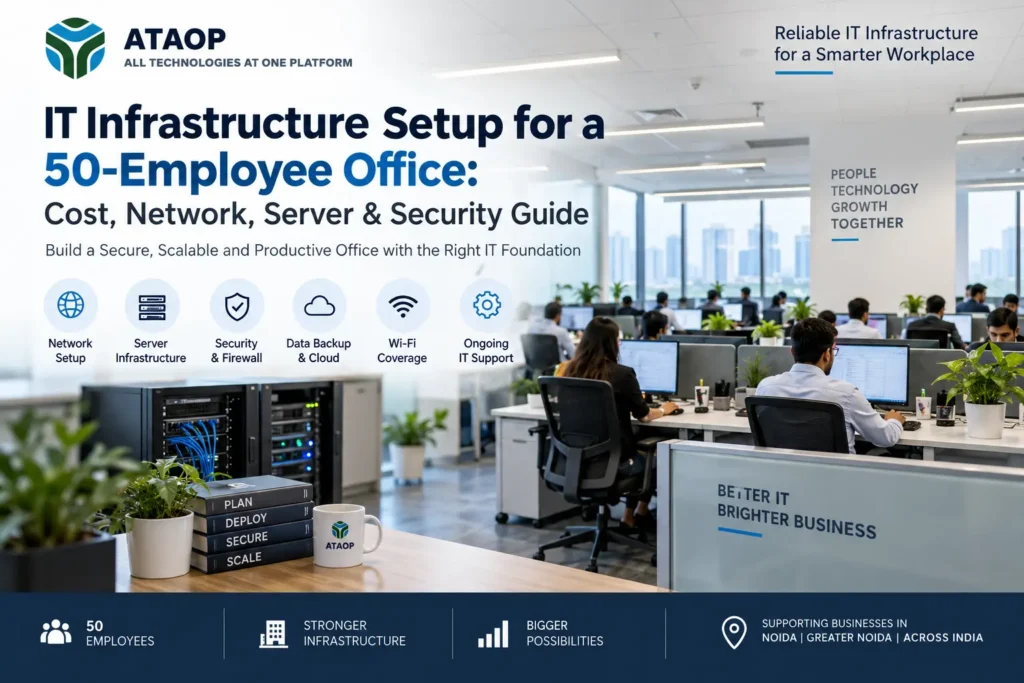
Setting up an office for 50 employees involves much more than buying laptops and arranging an internet connection. Your team needs reliable Wi-Fi, secure networking, shared data access, backup, cybersecurity, communication systems and ongoing technical support to work efficiently.
Poorly planned infrastructure can result in slow internet, Wi-Fi dead zones, server downtime, security risks and expensive upgrades shortly after the office becomes operational.
That is why an IT infrastructure setup for a 50-employee office should be planned around current requirements as well as future business growth.
Whether you are opening a new office in Noida, relocating an existing workplace or expanding from 20 to 50 employees, this guide explains the essential IT infrastructure, network and server requirements, security considerations and major factors that determine the overall setup cost.
What IT Infrastructure Does a 50-Employee Office Need?
The exact requirements depend on the nature of the business. A software company, hospital administration office, manufacturing unit and professional services firm may all have different technology needs.
However, a typical 50-user office IT setup may require:
- Business internet connection
- Structured LAN cabling
- Network rack and patch panels
- Managed network switches
- Business-grade Wi-Fi access points
- Router and firewall
- Server or cloud infrastructure
- Desktop computers or laptops
- Data backup solution
- Endpoint security
- VPN or secure remote access
- Printers and shared peripherals
- CCTV and access control where required
- UPS and power backup
- IT monitoring and maintenance
Planning these systems together is generally more effective than purchasing each component independently.
1. Start with the Office Network
The network is the foundation of your office IT infrastructure.
Employees rely on it to access the internet, servers, printers, cloud applications, shared files and other business resources.
For a 50-employee office network setup, planning should begin with the office layout.
Identify where employees will sit, meeting rooms, reception areas, printers, servers, Wi-Fi access points and other network-connected equipment.
Structured Cabling
Even when employees primarily use Wi-Fi, structured cabling remains important.
Ethernet connections may be used for:
- Desktop computers
- Servers
- Network printers
- Wi-Fi access points
- CCTV cameras
- IP phones
- Access control systems
Cat6 or another appropriate cabling standard can be selected based on network requirements, cable distance and expected performance.
Proper labeling and documentation also make future troubleshooting easier.
2. Switches and Network Rack
Network switches connect wired devices across the office.
For 50 employees, simply buying a 48-port switch may not always be sufficient because employees are not the only devices using network ports.
You may also need connections for:
- Access points
- Printers
- CCTV cameras
- Servers
- IP phones
- Meeting-room equipment
- Biometric devices
- Other network systems
Therefore, the number of ports should be calculated from the total device count plus reasonable expansion capacity.
Managed switches can also provide features such as VLANs, monitoring and traffic management.
Switches, patch panels, routers and related equipment can be organized inside a properly planned network rack.
3. How Many Wi-Fi Access Points Are Needed for 50 Employees?
There is no universal answer such as “50 employees require three access points.”
Wi-Fi requirements depend on:
- Office area and layout
- Walls and partitions
- Number of simultaneous users
- Number of devices per employee
- Meeting-room density
- Application usage
- Interference from surrounding networks
- Access point specifications
An employee may use a laptop and smartphone simultaneously, meaning 50 employees can quickly represent considerably more than 50 wireless devices.
A Wi-Fi site assessment is therefore more useful than choosing access points based only on employee count.
Business-grade access points should be positioned to provide appropriate coverage and capacity across work areas, meeting rooms and other important spaces.
4. Internet Connection for a 50-Employee Office
Internet bandwidth should be selected according to how the team works.
An office primarily using email and basic browser applications has different requirements from a business where employees regularly use:
- Video conferencing
- Cloud ERP or CRM
- Large file transfers
- Cloud backups
- VoIP calling
- Remote desktops
- Web applications
- Cloud-based document collaboration
Reliability can be just as important as headline internet speed.
Businesses heavily dependent on internet connectivity may consider a secondary internet connection for redundancy.
A dual-WAN capable firewall or router can be configured to support multiple connections where appropriate.
5. Does a 50-Employee Office Need a Server?
Not necessarily.
Some organizations can operate primarily with cloud-based applications and storage, while others require local servers for specific applications, centralized authentication, file storage, databases or other workloads.
Before purchasing a server for a 50-user office, determine what it will actually do.
Possible server workloads include:
- File sharing
- Active Directory
- Business applications
- Databases
- ERP
- Accounting software
- Backup
- Virtual machines
The server configuration should then be selected according to workload rather than simply employee count.
CPU, RAM, storage type, storage capacity, RAID configuration, operating system and backup strategy should all be considered.
6. Physical Server vs Virtualization vs Cloud
A growing business generally has several infrastructure options.
Physical Server
A dedicated physical server can be suitable for workloads that need local infrastructure or specific performance and control requirements.
Virtualized Server
Virtualization allows multiple virtual machines to operate on suitable physical infrastructure.
For example, different workloads may run in separate virtual environments rather than requiring a dedicated physical server for every application.
Cloud Infrastructure
Cloud infrastructure can reduce the requirement for some onsite hardware and provide flexibility for certain applications and workloads.
The right choice depends on performance, cost, application requirements, internet reliability, data requirements and internal technical capabilities.
Some 50-employee businesses use a hybrid IT infrastructure, combining local systems with cloud services.
7. Firewall and Network Security
A business network should not depend solely on the basic router supplied with an internet connection.
A properly configured business firewall can provide greater control over incoming and outgoing network traffic.
Depending on the selected solution, firewall capabilities may include:
- Web filtering
- Application control
- VPN
- Intrusion prevention
- Traffic monitoring
- Network segmentation
- User policies
- Security logging
Businesses can also separate employee systems, servers, CCTV devices and guest Wi-Fi using network segmentation where appropriate.
For example, visitors using guest Wi-Fi generally do not need access to internal servers or business computers.
8. Endpoint Security for 50 Employees
Network security is only one layer of protection.
Employee laptops and desktops should also be appropriately protected.
An endpoint security strategy can include:
- Endpoint protection
- Operating system updates
- Security patching
- User access controls
- Device policies
- Disk encryption where appropriate
- Multi-factor authentication
- Controlled administrative privileges
Employee awareness is also important because phishing and unsafe account practices can create risks even when good security technology is deployed.
9. Backup and Data Protection
A server is not automatically a backup.
Likewise, keeping the only backup copy on storage permanently connected to the same system can create unnecessary risk.
A business backup solution should consider what data needs protection, how frequently it changes and how quickly it needs to be restored.
Businesses may use combinations of:
- Local backup
- NAS or dedicated backup storage
- Cloud backup
- Offsite backup
- Application-specific backup
The most important point is that backups should be monitored and periodically tested.
A backup job displaying “successful” is useful, but the organization should also understand whether important data can actually be restored when required.
10. CCTV, Access Control and IP Telephony
A complete office IT infrastructure setup may extend beyond computers and servers.
Depending on business requirements, the project may also include:
CCTV: IP cameras, network video recorder/storage and monitoring.
Access control: Door access systems and employee entry management.
Biometric attendance: Attendance systems integrated with HR processes where appropriate.
IP telephony: Business phone systems using the office data network.
Planning these requirements early is important because they may affect network ports, PoE switch capacity, cabling, storage and rack design.
How Much Does IT Infrastructure Setup Cost for a 50-Employee Office?
There is no responsible fixed price that applies to every 50-person office.
The IT infrastructure setup cost depends on the chosen equipment, office size, existing infrastructure and business requirements.
Major cost components can include:
| Infrastructure | Main Cost Factors |
| Structured cabling | Number of points, cable length, office layout |
| Network switches | Port count, speed, PoE, management features |
| Wi-Fi | Coverage area, user density, AP specifications |
| Firewall | Users, bandwidth, security features, licenses |
| Server | Workload, CPU, RAM, storage, redundancy |
| Backup | Data volume, retention and storage method |
| End-user devices | Desktop/laptop specifications |
| Security | Endpoint licenses, firewall subscriptions |
| CCTV | Camera count, storage and retention |
| UPS | Equipment load and required backup duration |
| Installation | Project complexity and configuration |
| Support | AMC, monitoring and response requirements |
Instead of beginning with a random budget, businesses should first define their requirements and then obtain an IT infrastructure quotation based on the actual office design.
Common Mistakes When Setting Up IT for 50 Employees
One common mistake is designing infrastructure for exactly 50 users.
If the business grows to 60 or 70 employees, an infrastructure designed with no spare capacity may require premature upgrades.
Other mistakes include buying consumer-grade networking equipment, installing Wi-Fi without proper planning, ignoring backup, using one flat network for every device, failing to document cabling and configurations, and purchasing a server before defining its workload.
Another mistake is focusing only on the initial setup cost.
Ongoing licenses, warranties, internet services, security subscriptions, backup storage and IT support should also be included when calculating the total cost of ownership.
IT Infrastructure Setup in Noida and Greater Noida
Businesses establishing offices in Noida, Greater Noida and Greater Noida West should ideally plan their technology requirements before employees move into the workspace.
Cabling, racks, access points, CCTV and network equipment are generally easier to implement while office interiors and electrical work are still being planned.
Early coordination between the interior, electrical and IT teams can also reduce unnecessary rework.
How ATAOP Can Help
ATAOP (OPC) Private Limited, based in Greater Noida West, provides business IT infrastructure solutions for organizations with requirements ranging from office networking and servers to cybersecurity and ongoing IT support.
For a new or expanding office, ATAOP can assist with areas such as structured networking, Wi-Fi, servers, firewalls, virtualization, backup, cybersecurity and IT AMC support based on the organization’s requirements.
Rather than treating every technology component as an isolated purchase, businesses can plan their network, server, security and future support requirements as one connected infrastructure project.
ATAOP also supports business requirements across India, with remote and onsite assistance depending on project scope and location.
Frequently Asked Questions
What IT infrastructure is needed for a 50-employee office?
A typical setup can include structured cabling, switches, Wi-Fi access points, firewall, internet connectivity, computers, server or cloud infrastructure, backup, endpoint security, UPS and ongoing IT support. Requirements vary by business.
How many Wi-Fi access points are required for 50 employees?
There is no fixed number. Access point requirements depend on floor area, layout, walls, user density, connected devices and applications. A Wi-Fi assessment provides a more reliable estimate.
Does a 50-user office need a server?
Not always. Some businesses can operate primarily in the cloud, while others require local servers for applications, file sharing, authentication, databases or other workloads.
How much does IT infrastructure cost for 50 employees?
Cost depends on office size, cabling points, network equipment, Wi-Fi, firewall, servers, security, backup and end-user devices. An infrastructure assessment is required for an accurate quotation.
Should a new office have a firewall?
Businesses should assess their security requirements rather than relying only on a basic internet router. A business firewall can provide capabilities such as VPN, traffic policies, network segmentation and additional security controls.