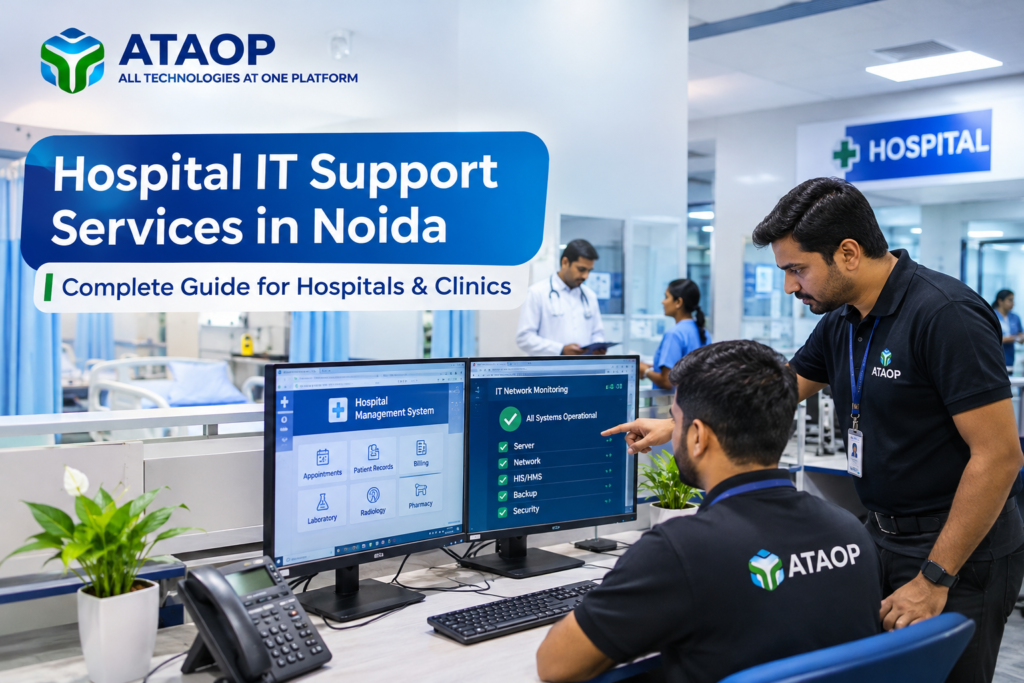
Modern hospitals depend on technology for almost every aspect of their operations, from patient registration and appointment scheduling to laboratory reporting, medical imaging and billing. When a hospital server fails, network connectivity becomes unstable or critical software stops responding, the disruption can affect healthcare workflows and access to important information.
For hospitals, clinics and diagnostic centres in Noida, Greater Noida and Delhi NCR, maintaining reliable IT infrastructure is essential.
This is where hospital IT support services in Noida become important.
Professional healthcare IT support helps medical facilities maintain computers, servers, networks, hospital management systems and data backup infrastructure. It also supports cybersecurity measures designed to protect sensitive patient information.
Whether you operate a small clinic or a multispecialty hospital, understanding the scope of healthcare IT services can help you choose the right technical support partner.
This guide explains what hospital IT support includes, common infrastructure challenges, outsourcing benefits, maintenance costs and how to select a suitable IT service provider.
What Are Hospital IT Support Services?
Hospital IT support services involve the installation, maintenance, monitoring and troubleshooting of technology used in healthcare facilities.
Unlike general office IT maintenance, hospital IT support must account for interconnected clinical and administrative systems, sensitive information and the potential operational consequences of downtime.
Healthcare organizations may require assistance with:
- Desktop computers and workstations
- Hospital Information Systems (HIS)
- Hospital Management Systems (HMS)
- Electronic Health Records (EHR)
- Laboratory Information Systems (LIS)
- Medical imaging storage and PACS infrastructure
- Windows and Linux servers
- LAN, Wi-Fi and network equipment
- Firewalls and endpoint security
- Data backup and disaster recovery
The exact scope depends on the facility’s size, software platforms and operational requirements.
Why Do Hospitals and Clinics Need Dedicated IT Support?
Healthcare facilities often operate across multiple departments that depend on shared applications and network connectivity.
A network interruption at a registration desk can delay administrative processes. Server problems may affect access to records, while storage failures can disrupt access to digital reports or medical images.
Common Hospital IT Challenges
1. Server Downtime
Hospital applications may depend on centralized servers. Hardware failures, operating system errors or storage issues can interrupt access to essential services.
2. Network Connectivity Problems
Hospitals use wired and wireless networks across reception areas, laboratories, pharmacies, administrative departments and clinical workspaces.
3. Data Security Risks
Healthcare organizations handle sensitive patient and business information, making access control, endpoint security and secure data handling important.
4. Software and Device Integration
Hospital applications may need to communicate with laboratory systems, billing platforms and other connected equipment.
5. Limited Internal IT Resources
Smaller hospitals and clinics may not have specialists available for server administration, networking, cybersecurity and infrastructure troubleshooting.
A structured hospital IT maintenance plan can help address these challenges before they lead to extended disruptions.
1. Hospital Server Installation and Maintenance
Servers form an important part of healthcare IT infrastructure.
They may host hospital management applications, databases, file-sharing services and other business systems.
Professional hospital server support can include:
- Windows Server and Linux Server installation
- Server hardware configuration
- Storage and RAID management
- Operating system updates
- Virtualization support
- Performance monitoring
- Backup configuration
- Hardware and network troubleshooting
Why Is Preventive Server Maintenance Important?
Regular server health checks can help identify storage problems, resource limitations, hardware alerts and other developing issues.
For hospitals using HIS or HMS applications, server maintenance should be coordinated with the software vendor to reduce compatibility risks.
Critical updates and configuration changes should follow an approved maintenance process, including backup verification and rollback planning.
2. Hospital LAN and Wi-Fi Network Support
A reliable hospital network connects computers, servers, printers, administrative systems and authorized clinical devices.
Hospital network infrastructure may include managed switches, routers, firewalls, wireless access points and structured cabling.
What Does Hospital Network Support Include?
- LAN installation and troubleshooting
- Network switch configuration
- Router and firewall setup
- Wi-Fi access point management
- VLAN configuration
- Network performance monitoring
- Cabling and connectivity diagnostics
- Internet connectivity troubleshooting
Why Is Network Segmentation Important?
Different hospital departments and device categories may require different access permissions.
For example, guest Wi-Fi should generally be separated from internal hospital systems.
Similarly, connected medical devices may require dedicated network controls designed with clinical engineering teams and equipment manufacturers.
Proper network segmentation can help reduce unnecessary access between systems and limit the impact of certain security incidents.
3. HIS and HMS Infrastructure Support
Hospital Information Systems and Hospital Management Systems support administrative and, depending on the platform, clinical workflows.
These applications may handle patient registration, appointments, billing, inventory, reporting and other hospital processes.
Although HIS and HMS software vendors typically manage application-specific functionality, an infrastructure support provider can help maintain the underlying IT environment.
Common Infrastructure Responsibilities
- Server operating system maintenance
- Database server infrastructure coordination
- Network connectivity troubleshooting
- Storage availability monitoring
- User workstation configuration
- Backup infrastructure management
- Hardware performance diagnostics
Hospitals should clearly distinguish software vendor responsibilities from infrastructure support responsibilities in their service agreements.
4. Healthcare Data Backup and Disaster Recovery
Hospitals generate important digital information through registration systems, laboratory applications, imaging systems and administrative software.
Losing access to this information can disrupt operations and create recovery challenges.
A hospital data backup strategy should address both data protection and the ability to restore essential systems.
Recommended Backup Considerations
Regular Backups: Schedule backups according to the importance and rate of change of the data.
Offsite Protection: Maintain appropriately protected backup copies outside the primary infrastructure.
Access Restrictions: Limit backup administration privileges.
Encryption: Protect sensitive information in transit and at rest where appropriate.
Recovery Testing: Periodically verify that backups can be restored.
Recovery Objectives: Define acceptable recovery time and data-loss targets for important systems.
Hospitals should coordinate backup and recovery planning with application vendors, particularly when databases or clinical systems require specialized procedures.
5. Hospital Cybersecurity and Patient Data Protection
Healthcare organizations can face phishing attempts, ransomware, unauthorized access and other cybersecurity threats.
A successful attack may disrupt administrative systems or expose sensitive information.
Hospital cybersecurity should therefore involve multiple layers of protection.
Essential Security Controls
- Endpoint protection and malware detection
- Firewall configuration and monitoring
- Multifactor authentication where supported
- Role-based access control
- Security updates and vulnerability management
- Secure remote access
- Email security controls
- Backup protection
- Security awareness training
- Incident response planning
Why Is Role-Based Access Control Important?
Not every hospital employee requires access to every application or patient record.
Role-based access control helps organizations assign permissions according to job responsibilities.
For example, reception staff, billing teams, administrators and clinical professionals may require different levels of system access.
Hospitals should implement these controls in coordination with application vendors and their internal information governance policies.
Healthcare organizations in India should also assess applicable data protection, confidentiality and cybersecurity obligations rather than assuming that a general IT maintenance contract establishes legal compliance.
6. Desktop, Printer and Peripheral Support
Hospitals and clinics use numerous workstations across reception desks, billing counters, laboratories and administrative departments.
Routine technical issues can affect employee productivity and daily operations.
Hospital desktop support may include:
- Windows troubleshooting
- Computer hardware diagnostics
- Operating system installation
- Printer and scanner configuration
- Workstation performance optimization
- Software installation assistance
- Network connectivity troubleshooting
- Preventive device maintenance
Specialized medical equipment should be maintained by authorized biomedical engineers or equipment vendors. General IT engineers should not modify clinical device configurations without appropriate authorization.
7. Onsite vs Remote IT Support for Hospitals
Hospitals may require both remote technical assistance and physical onsite support.
| Support type | Typical responsibilities |
| Remote IT support | Software troubleshooting, monitoring, configuration assistance |
| Onsite IT support | Hardware inspection, cabling, workstation maintenance |
| Dedicated IT engineer | Regular technical assistance at the hospital |
| Managed IT services | Ongoing infrastructure support under an agreed scope |
| IT AMC | Contract-based preventive and corrective maintenance |
Which Support Model Is Better?
Small clinics may benefit from remote support combined with scheduled onsite visits.
Larger hospitals with extensive infrastructure may require dedicated onsite engineers supported by specialists in servers, networking and cybersecurity.
The correct model depends on operating hours, number of devices, system criticality and response-time requirements.
8. How Much Do Hospital IT Support Services Cost in Noida?
Hospital IT support costs depend on infrastructure size, technical complexity, required coverage and the support agreement. There is no single standard price for every healthcare facility.
Major Pricing Factors
| Factor | How it affects cost |
| Number of computers | More endpoints generally increase support workload |
| Server infrastructure | Physical and virtual servers require specialized maintenance |
| Network complexity | Multiple floors, buildings and VLANs increase support requirements |
| Support hours | Extended or 24/7 coverage may increase costs |
| Onsite engineer | Dedicated staffing differs from scheduled visits |
| Cybersecurity scope | Monitoring and specialist security services may be priced separately |
| Backup requirements | Storage, retention and recovery testing affect overall cost |
Hospital IT AMC vs On-Demand Support
An annual maintenance contract may provide predictable costs for defined maintenance services.
On-demand support is generally billed when assistance is requested.
For hospitals with frequent IT issues or important infrastructure dependencies, a structured support agreement may provide better continuity than relying entirely on emergency visits.
Before signing, confirm exclusions, hardware replacement charges, software licensing costs and escalation procedures.
9. Benefits of Outsourcing Hospital IT Support
Outsourcing healthcare IT infrastructure support can offer several operational advantages.
Access to Specialized Expertise
An external IT provider may offer access to professionals experienced in servers, networking, cloud platforms and infrastructure troubleshooting.
Predictable Maintenance Planning
Defined maintenance schedules and support agreements can help hospitals plan recurring IT expenses.
Reduced Administrative Burden
Hospital management teams can focus on healthcare operations while technical specialists handle agreed infrastructure responsibilities.
Improved Preventive Maintenance
Regular inspections and monitoring can help identify technical issues before they cause prolonged disruptions.
Flexible Service Coverage
Healthcare organizations can select onsite visits, remote support or dedicated engineer arrangements based on their requirements.
However, outsourcing does not remove a hospital’s responsibility for information governance, vendor oversight and operational risk management.
10. How to Choose a Hospital IT Support Company in Noida
Before selecting a healthcare IT support provider, hospital administrators should evaluate technical capabilities and service reliability.
Consider these questions:
- Does the provider have experience supporting business-critical server and network environments?
- Can the team coordinate with HIS, HMS, LIS and PACS software vendors?
- Are onsite support arrangements available for your location?
- Does the contract define response times and escalation procedures?
- How are administrator credentials and sensitive information protected?
- Are preventive maintenance and reporting included?
- What backup and disaster recovery responsibilities are covered?
- Are emergency support, hardware replacements and software licensing billed separately?
Request a written scope of work and verify any healthcare-specific experience or certifications claimed by the provider.
Hospital IT Support Services in Noida by ATAOP
ATAOP (OPC) Private Limited provides IT infrastructure and technical support services for businesses in Noida, Greater Noida, Delhi NCR and other supported locations across India.
For hospitals, clinics and diagnostic centres, ATAOP’s relevant technical service areas include:
- IT AMC and managed IT services
- Server installation and maintenance
- Windows and Linux server support
- Office LAN and Wi-Fi networking
- Firewall and network security configuration
- Desktop and workstation troubleshooting
- Data backup and recovery infrastructure
- Microsoft 365 and business email support
- Onsite and remote IT support arrangements
Healthcare organizations can contact ATAOP to discuss their existing infrastructure, technical challenges and support requirements.
Specialized healthcare application integrations, medical equipment maintenance and regulatory compliance work should be assessed separately according to the required expertise and service scope.
Looking for Hospital IT Support Services in Noida?
Contact ATAOP to discuss your hospital or clinic’s IT infrastructure and request a customized support quotation.
Website: https://ataop.com/
Frequently Asked Questions
What are hospital IT support services?
Hospital IT support services involve maintaining and troubleshooting computers, servers, networks, security systems and the technical infrastructure supporting healthcare applications.
Why do hospitals need IT maintenance?
Hospitals depend on interconnected digital systems for administrative and clinical workflows. Regular IT maintenance helps reduce avoidable technical disruptions and supports system reliability.
How much does hospital IT AMC cost in Noida?
Costs vary according to the number of computers, servers, network devices, support hours and agreed services. A site assessment is usually needed for an accurate quotation.
Can an IT support company maintain HIS and HMS servers?
A qualified IT infrastructure provider can maintain the underlying servers, storage and networks. Application-specific updates and troubleshooting may require coordination with the HIS or HMS vendor.
What is the difference between hospital IT AMC and managed IT services?
IT AMC typically covers defined maintenance activities, while managed IT services may include broader monitoring, support management and infrastructure administration. Actual coverage depends on the contract.
Do small clinics need professional IT support?
Yes. Even small clinics may depend on computers, appointment systems, internet connectivity, printers and secure data storage. Their support requirements can be met through an appropriately sized service plan.
How can hospitals protect patient information?
Hospitals should use appropriate access controls, secure authentication, endpoint protection, backups, staff training and incident response procedures, alongside applicable legal and organizational safeguards.
Does ATAOP offer hospital IT support in Noida?
ATAOP provides IT infrastructure and support services relevant to hospitals and clinics in Noida and Delhi NCR. Healthcare organizations should contact ATAOP to confirm the required service scope and onsite availability.