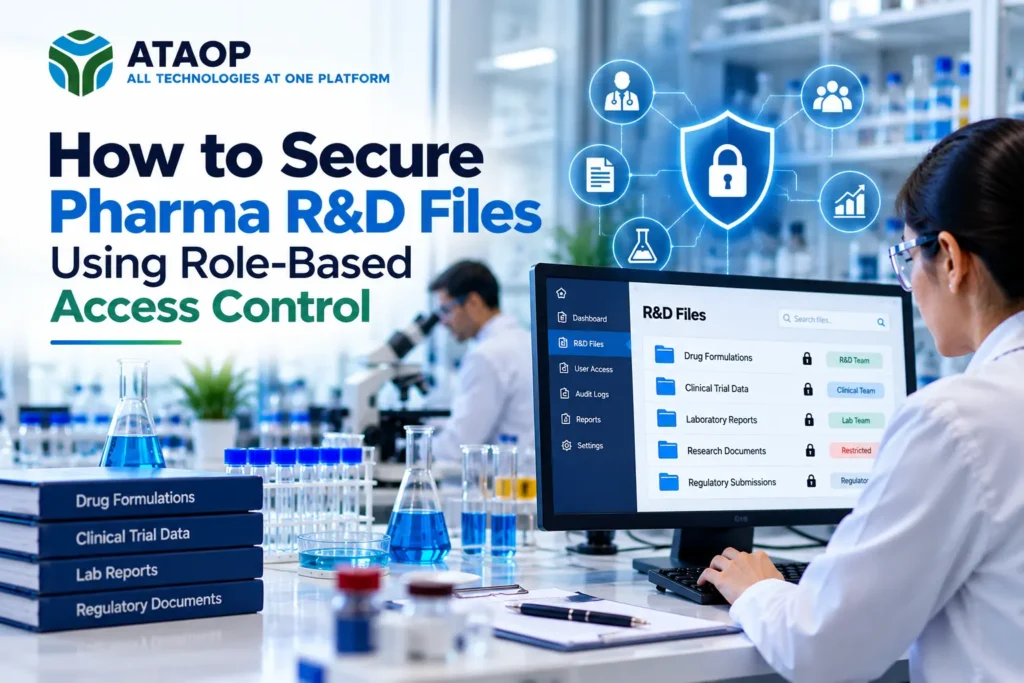
Pharmaceutical research involves years of scientific investigation, drug development, clinical trials and regulatory documentation. During this process, organizations generate confidential information that must be protected against unauthorized access, accidental modification and data loss.
From drug formulations and laboratory reports to clinical trial records and intellectual property, pharmaceutical R&D files are among an organization’s most valuable digital assets.
But here’s an important question: Who should have access to your company’s confidential research documents?
Giving every employee unrestricted access to sensitive information can create serious cybersecurity, operational and compliance risks.
This is where Role-Based Access Control (RBAC) becomes important.
In this guide, we’ll explain how to secure pharma R&D files using Role-Based Access Control, including practical implementation steps, document security best practices, audit trails and considerations for pharmaceutical IT infrastructure.
What Is Role-Based Access Control in Pharma?
Role-Based Access Control (RBAC) is a security approach that assigns system permissions according to an employee’s job responsibilities rather than providing unrestricted access to organizational information.
In pharmaceutical companies, different departments require access to different types of research documents.
For example, formulation scientists may need access to drug development records, while quality assurance personnel require access to relevant validation and quality documentation.
RBAC helps organizations ensure that employees can access only the information necessary for their assigned responsibilities.
How Does RBAC Work?
Role-Based Access Control generally involves three components:
- Users: Employees, researchers, laboratory technicians and administrators.
- Roles: Defined job functions such as R&D Scientist, QA Manager or Regulatory Affairs Officer.
- Permissions: Authorized actions such as viewing, editing, approving, downloading or sharing documents.
When properly configured, RBAC supports the principle of least privilege, reducing unnecessary access to sensitive pharmaceutical information.
Why Is Pharma R&D Data Security Important?
Pharmaceutical organizations manage confidential research information throughout the drug development lifecycle.
Unauthorized access or modification can compromise intellectual property, disrupt research activities and affect the reliability of scientific records.
Common Types of Sensitive Pharma Data
- Drug formulations and manufacturing research
- Clinical trial data and supporting documentation
- Laboratory test results
- Analytical method development records
- Stability study reports
- Research protocols and experimental findings
- Regulatory submissions
- Quality assurance and validation documents
These records may be stored across laboratory systems, file servers, cloud platforms and document management applications.
Without appropriate access controls, employees may unintentionally or deliberately access information beyond their responsibilities.
A structured pharmaceutical data security strategy helps reduce these risks while supporting controlled collaboration.
1. Identify and Classify Confidential R&D Documents
Before implementing RBAC, pharmaceutical organizations should identify which documents require protection.
Not every file needs the same security restrictions.
For example, general administrative documents may require fewer controls than confidential drug formulations or sensitive clinical research records.
Recommended Data Classification
| Data category | Example | Suggested protection |
| Public | Published research information | General access |
| Internal | Departmental procedures | Employee access |
| Confidential | Laboratory reports and R&D records | Restricted departmental access |
| Highly confidential | Drug formulations and sensitive trial data | Strict role-based access |
Classification helps IT administrators establish suitable permissions and security policies.
It also reduces the likelihood of applying unnecessary restrictions to ordinary business documents.
2. Define User Roles and Access Permissions
Once research documents are classified, organizations should define roles according to business responsibilities.
Permissions should be based on actual work requirements rather than employee seniority alone.
Example RBAC Structure for a Pharmaceutical Company
| Department | Typical access requirements |
| R&D Team | Assigned research and formulation documents |
| Laboratory Team | Relevant laboratory records and test results |
| Quality Assurance | Quality records, reviews and approved documentation |
| Regulatory Affairs | Relevant regulatory submissions and supporting records |
| IT Administrators | System administration without unnecessary access to research content |
| External Collaborators | Time-limited access to specifically approved documents |
These are illustrative roles. Actual permissions should be approved by appropriate business and data owners.
Apply the Principle of Least Privilege
Least privilege means granting only the permissions necessary to perform an assigned task.
For example, a laboratory technician may need permission to enter test results but should not automatically have authority to approve final quality records.
Separating responsibilities helps reduce accidental changes and unauthorized activity.
3. Implement Secure Document Management
Pharmaceutical research teams often share files across departments, locations and external collaborators.
A secure document management system can help organizations manage these activities while maintaining appropriate access restrictions.
Important Document Security Features
Role-Based Permissions: Control which users can view, modify, approve or share documents.
Version Control: Maintain document versions and track authorized revisions.
Secure Storage: Protect stored information through appropriate encryption and infrastructure security.
Controlled Sharing: Restrict external access and unauthorized distribution.
Document Recovery: Maintain suitable backup and restoration capabilities.
Organizations should also consider document approval workflows, retention requirements and system validation where applicable.
A secure R&D document management solution should support both scientific collaboration and information protection.
4. Enable Multifactor Authentication
Passwords alone may not provide sufficient protection for sensitive pharmaceutical systems.
Compromised credentials can allow attackers to access confidential research documents.
Multifactor authentication (MFA) adds another verification requirement when users sign in.
Why MFA Matters for Pharma IT Security
MFA can help reduce the risk of unauthorized access resulting from stolen passwords.
For example, a researcher accessing a cloud-based R&D document repository may need to complete an additional authentication step.
Organizations should prioritize phishing-resistant authentication methods where practical.
MFA should be combined with RBAC, device security and appropriate session controls rather than treated as a complete security solution.
5. Maintain Audit Trails for Research Documents
Audit trails are important for accountability and data integrity in pharmaceutical environments.
They provide records of relevant system and user activities.
Depending on the system and applicable requirements, audit trails may record:
- User identity
- Date and time of activity
- Document creation or modification
- Permission changes
- Approval actions
- Relevant record deletion or status changes
Why Are Audit Trails Important?
Audit trails can help organizations investigate unusual activity, reconstruct significant record changes and support applicable regulatory requirements.
For example, if a laboratory report is modified after review, an appropriately configured audit trail may help identify who made the change and when.
However, simply enabling logging does not automatically establish regulatory compliance.
Audit trails must be appropriately protected, retained and reviewed according to documented procedures.
6. Protect Pharma R&D Files on Servers and Cloud Platforms
Pharmaceutical companies may store research documents on Windows file servers, network-attached storage, SharePoint, cloud repositories or specialized laboratory applications.
Each platform requires suitable security configuration.
Windows Server File Security
For Windows-based environments, administrators can use Active Directory security groups and NTFS permissions to implement access restrictions.
For example, an R&D security group may receive access to a designated research folder while unrelated departments are denied unnecessary permissions.
Administrators should review both NTFS and network share permissions.
Cloud Document Security
Cloud platforms can support identity-based access controls, controlled sharing and monitoring.
For Microsoft 365 environments, organizations may use SharePoint permissions, Microsoft Entra ID groups and additional security capabilities according to their licensing.
Sensitive research information should not be shared through unrestricted public links.
Cloud configuration should also account for external collaboration, device security and data retention requirements.
7. Review Access Rights Regularly
Employee responsibilities change over time.
Researchers may move between projects, contractors may complete assignments and employees may leave the organization.
Without periodic access reviews, unnecessary permissions can accumulate.
Recommended Access Review Process
- Identify users with access to confidential research repositories.
- Compare permissions with current responsibilities.
- Review privileged and external accounts.
- Remove unnecessary access.
- Document approvals and significant changes.
- Repeat reviews according to organizational risk.
Access should also be reviewed promptly following employee transfers, departures or changes in project responsibilities.
This helps prevent former employees and unauthorized users from retaining access to confidential R&D files.
8. Implement Data Backup and Disaster Recovery
Role-Based Access Control protects access to information, but it does not prevent every form of data loss.
Hardware failures, ransomware, accidental deletion and software errors can still affect research documents.
Pharmaceutical organizations should maintain a documented backup and disaster recovery strategy.
Important Backup Practices
- Schedule backups according to business requirements.
- Maintain protected or immutable backup copies where appropriate.
- Restrict access to backup administration.
- Monitor backup failures.
- Test restoration procedures periodically.
- Define recovery time and recovery point objectives.
Backup systems should preserve required records and metadata where applicable.
Organizations must also consider regulatory retention and record integrity requirements when designing recovery procedures.
9. Consider Pharmaceutical Data Integrity Requirements
Pharmaceutical IT security is closely connected to data integrity.
The ALCOA+ principles provide a widely used framework for evaluating trustworthy records.
These principles include:
- Attributable
- Legible
- Contemporaneous
- Original
- Accurate
- Complete
- Consistent
- Enduring
- Available
Role-Based Access Control can support data integrity by restricting unauthorized changes and helping associate activities with authorized users.
However, RBAC alone does not satisfy all data integrity requirements.
Organizations may also need validated computerized systems, controlled workflows, electronic signature controls and documented procedures.
What About 21 CFR Part 11?
For organizations subject to applicable US FDA requirements, 21 CFR Part 11 addresses certain electronic records and electronic signatures.
Relevant controls may include system access restrictions, audit trails and authority checks.
The exact requirements depend on the records, system use and regulatory context.
Organizations should work with qualified quality, regulatory and validation professionals when determining compliance obligations.
10. Monitor and Improve R&D Access Security
Implementing RBAC is not a one-time activity.
As pharmaceutical organizations expand their research programs, introduce new applications and collaborate with external partners, access requirements change.
IT teams should monitor:
- Unusual login activity
- Repeated failed authentication attempts
- Privileged account usage
- Unexpected permission changes
- Unauthorized sharing attempts
- Relevant security alerts
Security monitoring should be proportionate to the sensitivity of the information and the risks involved.
Regular access reviews, security assessments and employee awareness training can strengthen the overall protection of research information.
Common Mistakes in Pharma Role-Based Access Control
Even organizations with access management systems can experience security weaknesses.
Common mistakes include:
- Giving broad access to entire departments.
- Using shared user accounts.
- Allowing excessive administrator privileges.
- Failing to remove access after employee departures.
- Leaving external sharing unrestricted.
- Neglecting audit trail monitoring.
- Failing to review access permissions after organizational changes.
Avoiding these mistakes requires coordination between IT, research, quality assurance and management teams.
Pharma IT Infrastructure and Data Security Services in Noida – ATAOP
Pharmaceutical companies and research laboratories need secure, reliable IT infrastructure to support sensitive digital information.
ATAOP (OPC) Private Limited provides business IT infrastructure and technical support services from Noida, serving Greater Noida, Delhi NCR and organizations across India.
ATAOP’s relevant IT solutions include:
- Windows and Linux server management
- Network security and firewall configuration
- User access management
- Secure file storage infrastructure
- Microsoft 365-related IT support
- Data backup and disaster recovery
- IT infrastructure maintenance
- Managed IT services
For pharmaceutical and research organizations, properly designed infrastructure and access controls can help reduce unauthorized access risks and improve operational reliability.
ATAOP can assist businesses with assessing IT infrastructure requirements and implementing suitable technical security controls.
Regulated environments may additionally require specialized validation and compliance assessments.
To discuss your organization’s IT infrastructure or document security requirements, visit https://ataop.com/.
Frequently Asked Questions
What is RBAC in the pharmaceutical industry?
RBAC is a security method that assigns access permissions based on job roles. It helps ensure that pharmaceutical employees access only the research documents and systems necessary for their responsibilities.
How can pharma companies protect confidential drug formulations?
Organizations can use restricted permissions, multifactor authentication, encryption, secure document management, audit trails and regular access reviews to protect confidential formulations.
What is the difference between RBAC and ABAC?
RBAC grants permissions according to defined roles. Attribute-Based Access Control (ABAC) evaluates additional attributes, such as department, device, location or document sensitivity, when making access decisions.
Why are audit trails important in pharma?
Audit trails help record relevant user and system activities, supporting accountability, investigations, data integrity and applicable regulatory requirements.
Can Microsoft 365 be used for secure pharma document management?
Microsoft 365 offers access management and document security capabilities. However, suitability for regulated pharmaceutical records depends on configuration, licensing, intended use, validation and applicable compliance requirements.
Does RBAC guarantee 21 CFR Part 11 compliance?
No. RBAC supports access control, but Part 11 compliance may require additional technical, procedural and administrative controls.
How often should pharma access permissions be reviewed?
Review frequency should depend on data sensitivity, regulatory requirements and organizational risk. Access should also be reassessed whenever an employee’s role or employment status changes.
Conclusion
Securing pharmaceutical research information requires more than password-protecting files or restricting access to a shared folder.
Role-Based Access Control helps pharma organizations protect confidential R&D documents by assigning permissions according to job responsibilities.
When combined with multifactor authentication, secure document management, audit trails, backups and regular access reviews, RBAC becomes an important part of a broader pharmaceutical cybersecurity strategy.
Organizations should begin by identifying sensitive research records, defining appropriate user roles and reviewing their existing document access policies.
For pharmaceutical companies and research organizations in Noida, Greater Noida and Delhi NCR, ATAOP (OPC) Private Limited provides IT infrastructure and managed IT support solutions relevant to secure business operations.
Protect Research. Control Access. Strengthen Data Security.