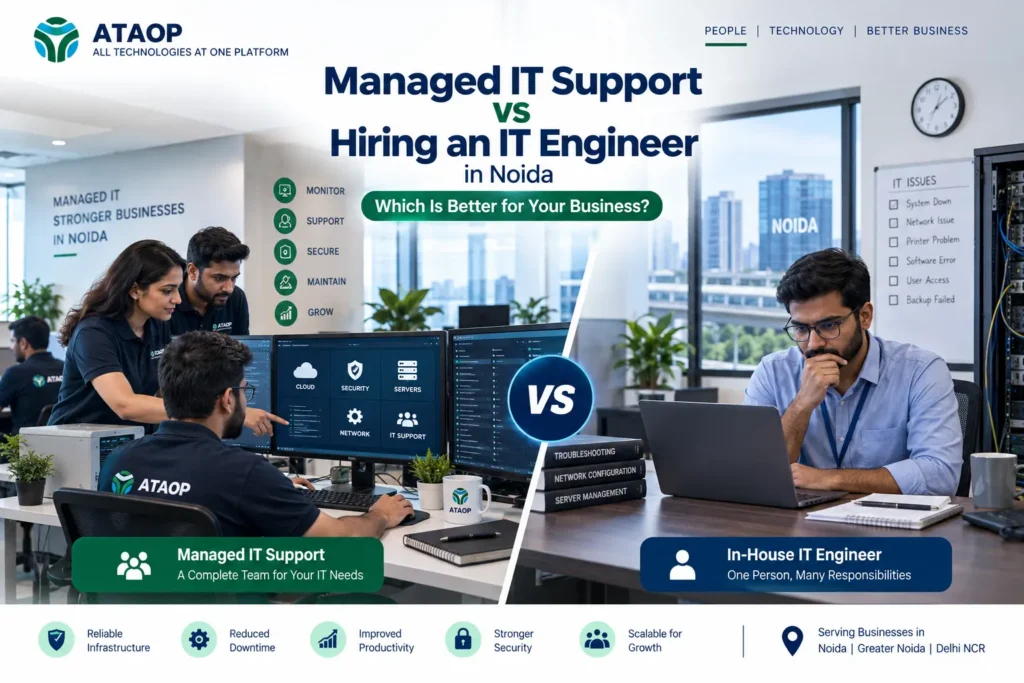
As businesses grow in Noida and Greater Noida, managing IT infrastructure becomes increasingly challenging. Computers require maintenance, servers need monitoring, office networks experience connectivity issues, and cybersecurity threats demand continuous attention.
For startups, small businesses and growing organizations, one important question often arises: Should you hire a full-time IT engineer or outsource IT support to a managed IT services company?
Both approaches have advantages. Hiring an in-house IT engineer provides direct access to a dedicated employee, while managed IT support in Noida can offer access to a broader range of technical expertise through a service agreement.
However, the right decision depends on your company’s size, infrastructure, support requirements, budget and future growth.
This guide compares managed IT services vs in-house IT support, including costs, technical expertise, availability, cybersecurity, server management and the factors businesses should consider before choosing.
What Is Managed IT Support?
Managed IT support is a service model in which a business outsources some or all of its IT management responsibilities to an external service provider.
Instead of employing separate specialists for computers, networking, servers and cybersecurity, organizations can work with a managed IT services provider under an agreed scope of support.
Typical services include:
- Desktop and laptop troubleshooting
- IT helpdesk and remote support
- Server monitoring and maintenance
- Office network and Wi-Fi management
- Firewall configuration and security support
- Operating system updates and patch management
- Data backup monitoring
- IT infrastructure maintenance
- Hardware and software troubleshooting
- Preventive maintenance
- Onsite technical assistance
For example, a 40-employee company operating desktops, laptops, a file server, printers and business Wi-Fi may choose an IT AMC and managed support agreement rather than maintaining a dedicated internal IT department.
The provider’s responsibilities, response times and service availability should be clearly defined in the contract.
What Does an In-House IT Engineer Do?
An in-house IT engineer is a company employee responsible for managing internal technology systems and assisting users with technical problems.
Depending on their experience, responsibilities may include maintaining employee computers, resolving software issues, configuring printers, managing user accounts, troubleshooting networks and assisting with server maintenance.
For organizations with regular hands-on technical requirements, having an engineer physically present can be valuable.
However, a single engineer may not possess advanced expertise across every IT discipline.
For instance, someone experienced in desktop troubleshooting may have limited knowledge of enterprise firewall configuration, virtualization, database administration or disaster recovery.
This makes the engineer’s skill set an important consideration when comparing internal hiring with outsourced IT support services.
Managed IT Support vs In-House IT Engineer: Key Differences
| Comparison | Managed IT Support | In-House IT Engineer |
| Employment model | External service provider | Direct company employee |
| Cost structure | Contract or recurring service fee | Salary and employment-related expenses |
| Technical expertise | Access to multiple specialists, depending on provider | Depends on employee’s skills |
| Onsite availability | Based on agreement | Available during assigned working hours |
| Remote support | Usually available within agreed scope | Depends on company arrangements |
| Server management | May include specialist support | Depends on engineer’s expertise |
| Cybersecurity | Can include dedicated security services | May require additional specialists |
| Employee absence | Provider may arrange alternative resources | Backup coverage must be planned |
| Scalability | Support scope can be adjusted contractually | May require additional hiring |
| Control | Shared with external provider | Greater direct operational control |
Neither model is automatically superior. The best arrangement depends on how the organization operates.
1. Cost Comparison: Managed IT Support vs Hiring an IT Engineer
Cost is often the first concern for small business owners.
Cost of Hiring a Full-Time IT Engineer in Noida
Hiring an employee involves more than the monthly salary.
Businesses may also need to consider recruitment, onboarding, training, employee benefits, leave coverage, equipment and replacement costs.
The overall expense depends on the engineer’s experience and technical responsibilities.
A junior desktop-support engineer and an experienced server or network administrator should not be treated as equivalent hires.
Businesses requiring multiple technical disciplines may eventually need additional specialists or external vendors.
Cost of Managed IT Services in Noida
The cost of managed IT support services in Noida generally depends on:
- Number of employees and devices
- Number of servers
- Network complexity
- Firewall and security requirements
- Onsite visit frequency
- Remote support requirements
- Support hours
- Response-time commitments
- Preventive maintenance scope
Some providers offer per-device pricing, while others use customized monthly or annual agreements.
Which option is cheaper?
There is no universal answer. A small company with occasional technical problems may find outsourced support more economical, while an organization requiring continuous physical assistance may benefit from an internal engineer.
Compare the complete annual cost of both arrangements rather than salary against AMC fees alone.
2. Technical Expertise and Problem Resolution
Modern office IT infrastructure consists of several interconnected technologies.
A network issue might involve switches, wireless access points, firewall policies, DNS configuration or server connectivity.
Similarly, an ERP performance problem may originate from insufficient server memory, storage performance, database configuration or network congestion.
One IT engineer may understand some of these areas but not necessarily all of them.
A capable managed IT services company may provide access to professionals specializing in networking, Windows and Linux servers, virtualization, cybersecurity and cloud infrastructure.
However, businesses should verify the provider’s actual capabilities rather than assuming every managed IT company has specialists in all technologies.
3. IT Support Availability and Response Time
One advantage of an in-house engineer is direct availability during working hours.
Employees can approach the engineer for immediate assistance with routine technical issues.
However, challenges may arise during leave, resignation, training or situations requiring unfamiliar expertise.
Managed IT support can provide an alternative escalation process and additional resources, depending on the agreement.
Before signing an IT support contract, ask:
- What are the support hours?
- Is remote assistance included?
- When is onsite support available?
- What is the response-time commitment?
- How are critical server failures handled?
- Is after-hours assistance available?
Do not assume that every IT AMC provider offers 24/7 support.
The service-level agreement should clearly define what is included.
4. Server and Network Infrastructure Management
Growing businesses often depend on shared folders, business applications, servers and network connectivity.
A server failure can prevent employees from accessing important files or applications.
Likewise, a poorly configured network can cause recurring connectivity problems across the office.
Professional server management and network support may involve system health checks, storage monitoring, network troubleshooting, firmware maintenance, backup verification and configuration management.
An experienced internal engineer can perform many of these tasks.
Managed support becomes particularly useful when an organization requires expertise across multiple technologies but does not have enough continuous work to justify employing separate specialists.
5. Cybersecurity and Data Protection
Cybersecurity should be considered when evaluating either support model.
Businesses may require firewall management, endpoint protection, secure remote access, software updates, user-permission reviews and backup monitoring.
An in-house IT engineer may handle routine security tasks, but specialized requirements such as firewall policy design or server hardening may require additional expertise.
A managed IT provider may offer these capabilities directly or through a separate cybersecurity service.
Businesses should confirm exactly which security responsibilities are included.
Outsourcing IT support does not automatically transfer all cybersecurity responsibility to the provider.
Both parties need clearly defined responsibilities for access control, backups, incident response and recovery.
6. Preventive Maintenance vs Reactive IT Support
Many businesses seek IT assistance only when something stops working.
An employee reports a slow computer, a printer becomes unavailable or the office Wi-Fi disconnects.
This reactive approach may resolve individual incidents without addressing recurring causes.
A structured preventive IT maintenance process can include periodic system checks, patch reviews, storage monitoring, backup verification and network-health assessments.
Both an in-house engineer and a managed IT provider can perform preventive maintenance.
The difference is whether the business has defined responsibilities, documentation and regular maintenance procedures.
For companies considering IT AMC services in Noida, preventive maintenance should be an important part of the service comparison.
7. Scalability for Growing Businesses
A company with 15 employees may have relatively simple IT requirements.
As the organization expands to 50 or 100 employees, it may require additional network switches, wireless access points, servers, software licenses, security controls and user-support capacity.
Managed IT support can provide contractual flexibility as infrastructure requirements change.
However, the provider must have sufficient resources to support expansion.
An in-house IT engineer may offer greater familiarity with internal operations, but increasing technical demands could eventually require more staff.
Businesses should evaluate their expected growth over the next two to three years before selecting a support model.
When Should a Business Hire an In-House IT Engineer?
Hiring an internal engineer may be suitable when a company requires continuous onsite technical assistance, has specialized internal applications or needs close day-to-day coordination with other departments.
An internal engineer can also be valuable when the organization maintains strict operational controls or has enough technical work to justify a dedicated position.
However, businesses should consider how specialist issues and employee absences will be handled.
When Should a Business Choose Managed IT Support?
Outsourced IT support in Noida may be appropriate for businesses that lack a dedicated IT department, require multiple technical skills or want a structured maintenance and support arrangement.
It can also be useful for organizations operating several offices or requiring assistance with servers, networking, cloud services and cybersecurity.
The most important consideration is whether the provider’s support scope matches the organization’s requirements.
Is a Hybrid IT Support Model Better?
For some organizations, the best option is not choosing one model exclusively.
A hybrid IT support model combines an internal IT employee with an external managed IT services provider.
For example, an internal engineer may handle employee onboarding, routine troubleshooting and coordination, while the external provider assists with advanced server administration, firewall management, virtualization and infrastructure upgrades.
This approach can help businesses retain internal control while accessing specialist expertise when needed.
How ATAOP Supports Businesses in Noida
ATAOP (OPC) Private Limited provides IT infrastructure and managed support services for businesses in Noida, Greater Noida and Delhi NCR.
ATAOP’s service capabilities include IT AMC, managed IT support, server infrastructure, office networking, business Wi-Fi, firewall and cybersecurity, virtualization, cloud solutions, backup and IT infrastructure maintenance.
Businesses evaluating outsourced IT support can discuss their existing environment, number of users, technical challenges and maintenance requirements to determine an appropriate service arrangement.
The objective is to support reliable business operations through practical IT management rather than treating every technical issue as an isolated problem.
Frequently Asked Questions
Is managed IT support cheaper than hiring an IT engineer?
It can be, particularly when a business needs several technical skills without requiring a full-time onsite employee. Actual costs depend on the service agreement, support hours, infrastructure and staffing requirements.
Can managed IT services replace an internal IT department?
For some small businesses, yes. Larger organizations may prefer combining managed IT services with internal IT staff.
What is included in managed IT support?
Services may include desktop support, network maintenance, server monitoring, troubleshooting, preventive maintenance, patching and remote assistance. Coverage varies by provider and contract.
What is the difference between IT AMC and managed IT services?
IT AMC commonly focuses on agreed maintenance and support coverage. Managed IT services may involve broader ongoing responsibilities such as monitoring, helpdesk management and infrastructure administration. The exact distinction depends on the provider’s offering.
Which IT support model is suitable for a 50-employee office?
A 50-employee company may use an internal engineer, managed IT support or a hybrid model. The right choice depends on applications, servers, network complexity, onsite needs and support expectations.
Can ATAOP provide managed IT support in Noida?
ATAOP (OPC) Private Limited provides IT AMC, managed support and infrastructure services for businesses in Noida and surrounding areas, subject to the agreed service requirements.